FlexSolar 120W Foldable Solar Panel Review After 6 Months: Great for Short Camping Trips
Some gear looks good on paper and then quietly gets left at home. The FlexSolar 120W has been the opposite for me.
After about 6 months of ownership and at least 5 outdoor uses, it has become my favorite foldable solar panel for the kind of camping I actually do: short 1-2 night trips where I want dependable power without turning camp into a power project.
That does not mean I think it is the right panel for everyone, or that it somehow ignores the normal limits of portable solar. A 120W panel is still a 120W panel. Weather matters. Panel angle matters. Bigger batteries and heavier loads still change the equation.
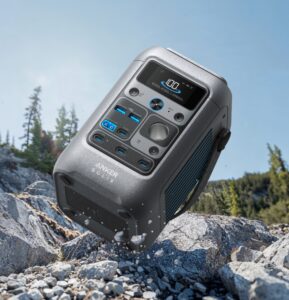
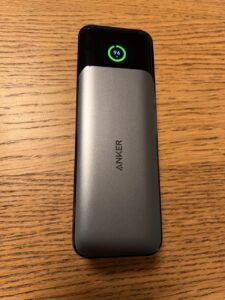
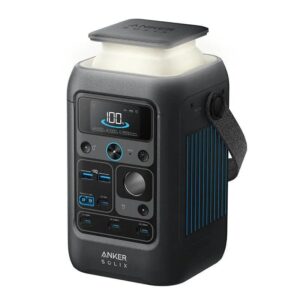
What has impressed me is something more practical than that. In my own use with an Anker C300 DC, Starlink Mini, and phone charging, I have repeatedly seen 100W+ on the C300 DC display in good conditions. Just as important, the panel has been easy enough to pack and deploy that I keep bringing it.
That combination is why this review is so positive.
Quick verdict
If you want the short version, this is where I stand:
– For my own short camping trips, this has become my favorite foldable solar panel.
– In good conditions, I have repeatedly seen 100W+ on my Anker C300 DC display.
– It has worked especially well in my setup with the Anker C300 DC, Starlink Mini, and phone charging.
– It is portable enough for car camping and short outdoor trips that I actually want to bring it.
– I do not have any major frustrations with it.
– My one real complaint is that my specific unit does not have built-in kickstands.
If your needs look a lot like mine – short trips, a small power station, modest ongoing loads, and a setup that is easy to live with – I think this panel makes a lot of sense.
My setup and where this panel fits
I think solar reviews are most useful when the setup is clear.
I am not using this panel in some abstract “portable power” scenario. I use it as part of a very specific system: the FlexSolar 120W feeding my Anker C300 DC, with that power station then handling my Starlink Mini and phone charging. That is the role I care about, so that is the role I am judging it on.
I am also not asking this panel to support a big off-grid camp, refill a much larger battery, or cover long trips with heavier daily power use. I bought it for exactly the kind of situation where a foldable panel either becomes genuinely useful or becomes one more thing to carry around.
For me, this one has been genuinely useful.
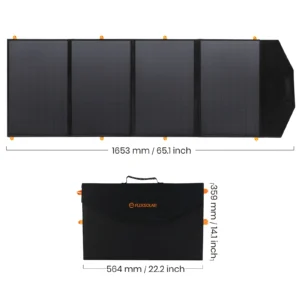
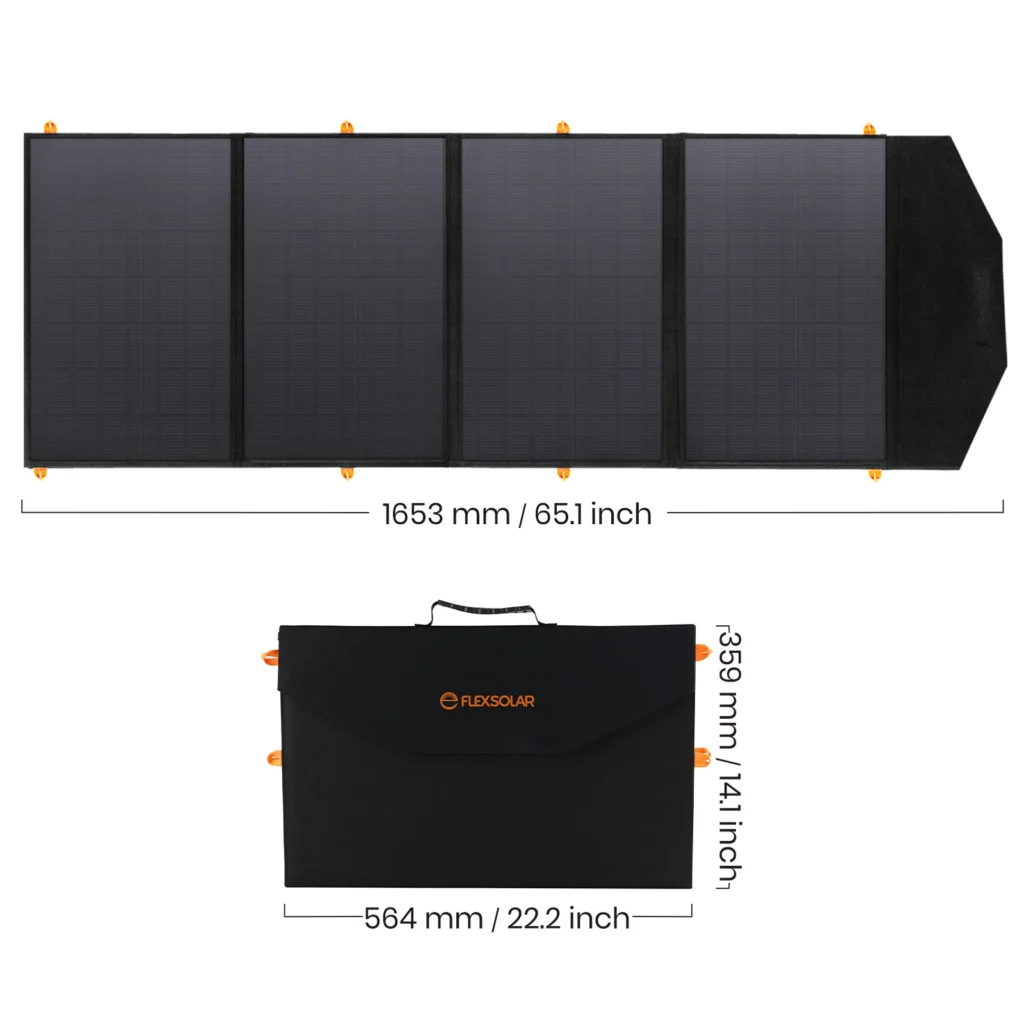
At about 4.9 kg / 10.8 lb, I would call it portable in the context of short-trip foldable solar use. I would not buy it for backpacking, and I would not describe it as lightweight in any broad sense. But for car camping, short overland stops, lakeside setups, and 1-2 night outings, I have found it manageable enough that I do not hesitate to pack it.
That matters more than specs sometimes do. Gear can perform well in theory and still be annoying enough that it never leaves the garage. This panel has not had that problem for me.
What came with my unit, and why version differences matter
This is one part of the review where I want to be especially precise, because not every listing seems to show the same version.
My specific unit came with MC4 connectors and about 2 meters of cable terminating in multiple connector options, including XT60, which works with my Anker C300 DC. In my setup, that was genuinely convenient. I did not have to figure out extra adapters just to use it the way I wanted.
I would not assume every FlexSolar 120W package currently being sold includes exactly the same cable bundle, though. Photos, listings, and included accessories can vary, so I only want to speak for the unit I actually own.
The same goes for the stand design.
My specific unit does not have built-in kickstands. That is worth being clear about because some listings or manuals appear to show versions that do. I cannot say how every version is packaged today. I can only say that the unit I own does not include kickstands, and that is the one meaningful improvement I wish it had.
Real-world performance: why I trust it
The main reason I like this panel is simple: in good sun, it has repeatedly delivered the kind of charging input that makes it feel worth bringing.
In my own use, I have seen 100W+ on the Anker C300 DC display more than once. I am not presenting that as a guarantee, and I am definitely not trying to turn my trips into a lab test. It is simply the pattern I have seen often enough that I trust it.
That is what matters to me.
A lot of portable solar gear can produce a nice number under ideal conditions. I care more about whether it feels useful in normal camp use – unfold it, point it generally where it should go, connect it, and let it work without constant fiddling. That is where this panel has done well.
It has performed closer to its rating than I expected from a foldable panel in this class, and it has done that in a way that feels practical rather than fragile.
The weekend trip that sold me on it
The trip that really locked in my opinion was a weekend outing with my kids in an area without cell coverage.
That made the Starlink Mini more important than usual. It was not just a nice extra to have along. It was the only real connectivity option.
The problem was that my Anker C300 DC started the day at around 5%. That is exactly the kind of moment where vague promises stop mattering. I needed the panel to do real work.
I unfolded the FlexSolar panel, propped it against a rock, aimed it generally toward the sun, and connected it to the C300 DC. I was not obsessively chasing the angle. I was not trying to create perfect test conditions. I just set it up in a sensible way and let it run.
On that outing, I saw 100W+ on the C300 DC display almost immediately.
More importantly, the overall result was excellent. In my real use that day, the battery went from roughly 5% to full in about 3.5 hours, while the Starlink Mini was also running. I want to frame that carefully, because I do not mean it as a benchmark or a promise of what everyone will get. It was simply what happened with my setup, in my conditions, on that trip.
It also matters that the Starlink Mini was the only active load besides charging. I am not claiming the panel was supporting a whole camp full of devices at once. But even with that clear limitation, I came away seriously impressed. Recovering a nearly empty power station while still supporting a live Starlink Mini is exactly the kind of practical result I want from a foldable camping panel.
What I liked most was how ordinary the setup was. I did not need a fancy mount. I did not have to baby it. I leaned it against a rock and it did its job.
That was the trip where this panel stopped feeling merely promising and started feeling trusted.
Another outing showed the same pattern
One good result can always be luck. What gave me more confidence was seeing the same basic behavior again.
On another outing, the weather was sunny, around 13C, and slightly windy. Once again, I had the panel propped against a rock and pointed generally toward the sun rather than perfectly dialed in.
Again, I saw above 100W on the Anker C300 DC display for sustained stretches.
That repeatability is the real story for me. I am not basing this review on one unusually good afternoon. Across multiple uses, the same pattern keeps showing up: easy setup, strong charging in good sun, and very little fuss.
Portability and setup: good enough to keep bringing
Performance is why I rate this panel so highly. Portability is why I keep packing it.
For my kind of camping, the FlexSolar 120W lands in a very good middle ground. It is not tiny, and it is not something I would ever describe as hiking gear. But it is still manageable enough for short outdoor trips that I do not talk myself out of bringing it.
That is a bigger compliment than it might sound like. Plenty of gear fails simply because it is annoying to use.
Setup is also straightforward, with one obvious caveat: because my unit does not have kickstands, I normally lean it against a rock or another stable surface. In practice, that has worked better than I expected. It is not elegant, but it has been effective.
Still, this is also where my one real complaint comes in. Built-in kickstands would make the panel easier to position and easier to live with. That would not change my overall opinion of the panel, but it is the clearest way I think my specific unit could be improved.
Durability after 6 months
I do not want to oversell durability after only about 6 months and at least 5 uses. That is enough time for a useful ownership impression, but not enough time to claim long-term proof.
What I can say is that the panel has felt solid so far. It has handled normal transport and outdoor use without giving me any reason for concern, and nothing about it has felt flimsy in day-to-day handling.
I also appreciate that the panel surface is easy to wipe clean. That sounds minor, but it matters with outdoor gear. Dust, smudges, and general campsite grime happen fast, and this one has been easy enough to clean that it never turns into a chore.
So my take here is positive, with the obvious limit that this is still an early ownership report rather than a multi-year durability verdict.
Who I think this panel is for
Based on how I actually use it, I think this panel makes the most sense for people who want:
– short 1-2 night camping trips
– a small power station such as the Anker C300 DC
– Starlink Mini use in the field
– phone charging and other light-to-moderate power needs
– a foldable panel that is easy enough to actually pack and deploy
– strong charging in good conditions without constant adjustment
That is the group I would recommend it to most confidently.
Who should probably look at something else
I would be more cautious about recommending it if your needs lean more toward:
– longer trips with heavier daily power use
– larger batteries that naturally take longer to refill
– a more permanent off-grid setup
– backpacking, where weight and packability matter more than panel output
– situations where built-in kickstands are a must-have
That is not a criticism of the panel so much as a reminder that I think this is a very good tool for a specific job.
If my trips were longer, my loads were heavier, or I wanted to build a more power-hungry camp setup, I would personally move up to a larger system rather than asking a 120W foldable panel to cover everything.
Final verdict
After about 6 months and at least 5 outdoor uses, the FlexSolar 120W has earned a very simple place in my gear: it is the foldable solar panel I most want to bring on short camping trips.
What sold me on it was not marketing, and it was not a perfect one-off test. It was repeated use with the kind of setup I actually care about. In good conditions, it has repeatedly shown 100W+ on my Anker C300 DC display, and the best example is still that weekend trip with my kids where it took the battery from around 5% to full in about 3.5 hours while the Starlink Mini was running.
That is not a promise. It is just the strongest real-world example of why I trust it.
Just as important, it has been easy to live with. It packs well enough, sets up quickly enough, and performs well enough that I keep choosing it again. My one real request is still the same: I wish my specific unit had built-in kickstands.
If your needs look like mine – short 1-2 night trips, a small power station, modest ongoing loads, and a preference for gear that is practical rather than impressive only on paper – I think the FlexSolar 120W is well worth considering.
Honestly, if I could afford it, I would buy another one as a spare. That is probably the clearest endorsement I can give it.